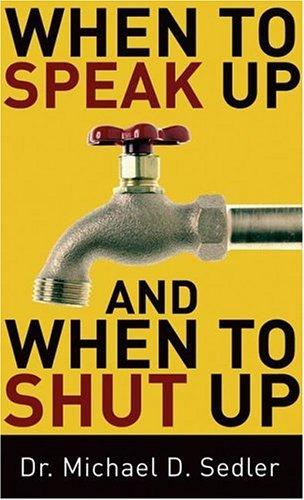
 Michael Sedler’s “When to Speak Up and When To Shut Up” aims to do exactly what it says on the tin - to offer guidance on when to speak or shut up. The tongue plays a critical role in our lives, as Sedler notes, "because of a misuse of the spoken word, destinies have been derailed, disunity has replaced unity, nations have been destroyed". By the same token, "silence can bring pain, destruction and the inevitable onslaught of sin. Or it can allow the time for God's healing power to work in a life". Judging when to speak or keep quite is therefore very important.
According to Sedler, we all face a strong temptation to remain silent when we should speak. Unfortunately, silence is not always golden. More often than note the failure to “speak up” at critical moments can have severe consequences. Indeed, when we choose to remain quiet when someone needs to speak up, we may also need to accept some responsibility for the outcome (as in Adam’s case).
The challenge of course is how to overcome the lure of silence. This problem arises in many situations. Peer pressure may force us to keep quiet rather than face the cost of going against the grain. Drawing on Reuben and Joseph in Genesis, Sedler suggests that Reuben serves as a prime example of someone who wrongly kept a 'code of silence'. Fear is undoubtedly at the heart of silence, particularly with respect to approaching “authority figures”. As is insecurity and loneliness. Sedler suggests that we can learn to speak up through fortifying ourselves with appropriate friendships; develop prior experience of issues; undertake appropriate research of facts; focus on the problem not people; improve the way we communicate; and being motivated by the desire to encourage and educate others, not ourselves.
The opposite challenge is also true – learning to keep quiet! Sedler says there’s such a thing as “God inspired silence” as demonstrated by Christ before Pilate. But often we fail to remain silent because of fear, pride and eagerness to 'control' outcomes. However, staying verbally quiet is not essentially about having few vocals. According to Sedler it is also about "choosing our words carefully so that we do not enter into anger ourselves”. A lot of common practical to-dos and don’t are suggested. Top of the list is avoiding anger; developing a spirit of forgiveness; and, learning to be accountable about our emotions.
How the balance between is struck is clearly challenging. Sedler suggests it is essentially a matter of having the ability to make "good decisions". Or what he calls "taking a stand for what we believe is right". That comes through a recognition that we all leaders. But that is not enough, we also need to surround ourselves with people who have a strong relationship with God; are faithful; and, bold to speak the truth. We also need to learn practically how to make appeals that increases the likelihood of being heard by people who may have a different opinion from us!
So what are we to make of Sedler’s effort?
It is certainly an interesting book in so far as it deals with an issue that has been left to secular business management courses. There are not many books in the Christian genre out there about how the virtue of silence and speaking. Some of the practical tips offered are particularly interesting. Though Sedler never quite goes as far as to say how some disciplines should be developed (e.g. avoiding fear) he does highlight good practical suggestions. It is not short on things to do! Also it be commended for not containing any obvious exegetical or theological errors. It is broadly sound.
However it does have some weaknesses. For one thing, the book tries to do too much. For example, at the start it comes across as a book purely about effective communication – talking and speaking up for one self – but later it becomes more about “standing up” for yourself and living right or faithfully before God. Though these things are related the issues involved are somewhat different. This is particularly problematic because though it adds value in relation to “practical tips” it is less comfortable when it deals with the central issues that underline our failure to “speak up” and “keep quiet”. Issues such as pride, fear, lack of forgiveness, failure to develop friendships, etc.
The other problem is that it seems to have followed the style of current Christian writing of the popular variety, aimed at too many audiences. Though the author does not explicitly define his audience, the general structure and message begins to emerge as we work our way through it. Though there are numerous references to biblical characters, this is a book that does not explicit set out its narrative within the Christian gospel themes of grace and redemption. It is quite steeped in the “do-it-yourself” or common sense behaviour variety, which widens its appeal to non-Christians but is likely to leave some Christian readers in a “no man’s land”.
In a way what this book does not say is it's major weakness. At the end of the day, when to speak up and shut comes from the foundational understanding of what Jesus Christ has already accomplished at the cross. It is understanding how the cross speaks to our everyday engagement with one another that would have given us a richer perspective to start from. This book will leave some Christian readers feeling guilty at their failure to speak up. It will leave them longing to be better, but it does not sufficiently and clearly point them to again at Christ as the final solution. The annex at the end does have the author’s testimony, but it seems like an add-on for information (or hope?), that is not sufficiently embedded in the main narrative.
Author Info:
Michael D Sedler ministers in churches and provides consultation services to schools and businesses throughout the United States. Michael is the author of Stop the Runaway Conversation and When to Speak Up When to Shut Up and works as an adjunct professor for three universities. He and his wife, Joyce, live in Spokane, Washington.
Comments
Post a Comment