Equilibrium is an excellent movie set in a futuristic world where a totalitarian government has solved the problem of violence by suppressing emotions. Books, art and music are strictly forbidden and feeling is a crime punishable by death. Christian Bale starts as Cleric John Preston, a top ranking government agent responsible for destroying those who resist the rules. When he misses a dose of Prozium, the mind-altering drug that hinders emotion, Preston suddenly begins to question the regime.
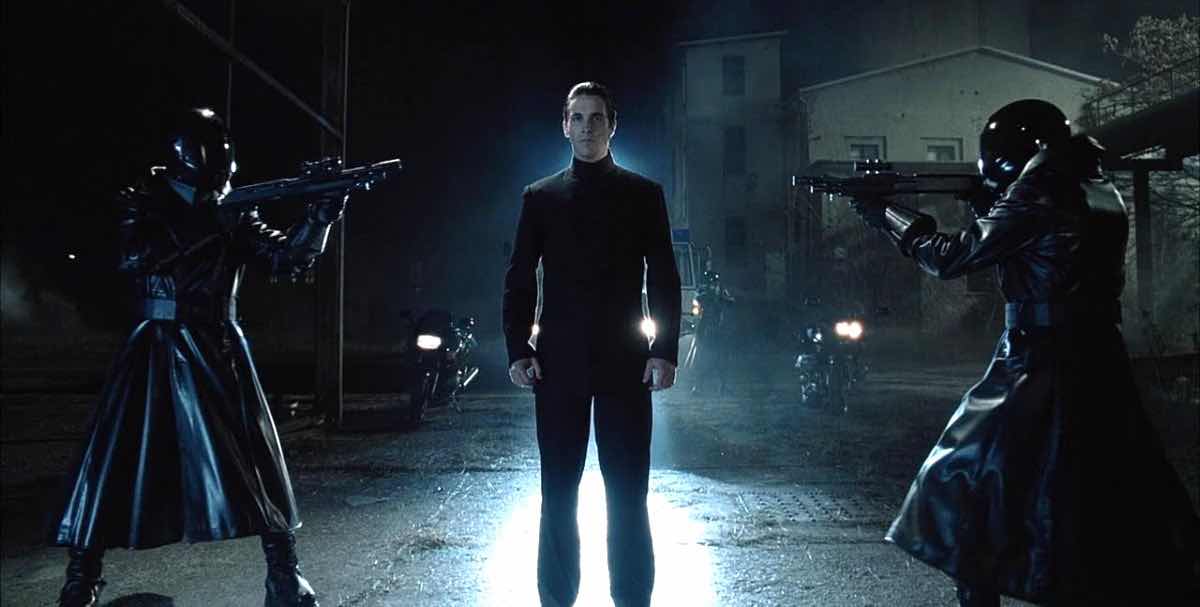
In one of the most fascinating scenes, John interviews Mary, a sense offender under custody :
Mary: Let me ask you something. [Grabs John's hand]Mary: Why are you alive?John Preston: [Breaks free] I'm alive... I live... to safeguard the continuity of this great society. To serve Libria.Mary: It's circular. You exist to continue your existence. What's the point?John Preston: What's the point of your existence?Mary: To feel. 'Cause you've never done it, you can never know it. But it's as vital as breath. And without it, without love, without anger, without sorrow, breath is just a clock... ticking
Mary is correct that John Preston’s answer is inadequate. John’s answer to the simple question is that man exists to continue existence. He exists to perpetuate civilisation. But he can’t say why – or in Mary’s blunt question “what’s the point”? It turns out John’s answer is actually very common. Many people believe there’s no purpose in existence per se. We just exist to exist!
Therefore the only purpose of existing is to exist. All naturalism, nihilism and many other worldviews hold this position. They believe there’s nothing out there outside the material world – so the purpose of our existence is simply existing to perpetuate our existence. Which of course is folly – a point John concedes by switching the burden back to Mary with the question – “What's the point of your existence?”
But in what is clearly one of the most underwhelming moment in all of cinema, Mary’s response does not impress either! [Though the producers must have felt it was the right answer – given the way it is given rhetoric force in the narrative]. Her response seems to anchor man's existence in a broad range of activity. Man can feel and through it experience other things. In other words, the essence of our existence is wrapped up into who we are as “feeling beings” with many diverse experiences. We exist to feel – and if we don’t feel we don’t exist because without feeling there's no experiences.
But that still only explains partly our nature, it does not explain our purpose. I say "partly" because Mary's explanation does not even fully explain our nature. A snake probably has many emotions – not least that of feeling pain, but that does not make it human. Similarly, the chimpanzee exhibits many traits of emotions but it is not human. To anchor the nature of being on being able to feel and relate to others is inadequate as a definition of human nature. I think the reason people do that is because they recognise that there must be something deeper about human beings. But unfortunately they relate this thing back only to the physical.
Both Mary and Preston are operating in a naturalistic framework which is closed system. Naturalism is not able to to explain "purpose". It can only explain "what". And of course the "what" without sufficient explanation of the "why" makes for circular reasoning.
The Christian worldview gives us both the what and the why. In Psalm 8, the Psalmist thunders, "What is mankind that you are mindful of them, human beings that you care for them? You have made them a little lower than the angels and crowned them with glory and honor. You made them rulers over the works of your hands; you put everything under their feet". Man is a special creation of God, bestowed with honour and glory from God. He carries God's divine imprint. Man's purpose is to serve God and exercise dominion over what God has created. He is God's vice regent. That is the point of his existence.
Both Mary and Preston are operating in a naturalistic framework which is closed system. Naturalism is not able to to explain "purpose". It can only explain "what". And of course the "what" without sufficient explanation of the "why" makes for circular reasoning.
The Christian worldview gives us both the what and the why. In Psalm 8, the Psalmist thunders, "What is mankind that you are mindful of them, human beings that you care for them? You have made them a little lower than the angels and crowned them with glory and honor. You made them rulers over the works of your hands; you put everything under their feet". Man is a special creation of God, bestowed with honour and glory from God. He carries God's divine imprint. Man's purpose is to serve God and exercise dominion over what God has created. He is God's vice regent. That is the point of his existence.
Comments
Post a Comment