Last week I achieved the impossible. I managed to convince my wife to watch the new science fiction movie Looper. The movie is written and directed by Rian Johnson and stars Bruce Willis and Joseph Gordon-Levitt. In 2072, time travel has been invented and immediately outlawed. It is now only used by the mob who find it useful as a way of getting rid of someone by sending them 30 years in the past, where an assassin (called a “looper”) finishes the job, paid with silver bars strapped to the target. The time fix helps the mob avoid trace, allowing the classic mob threat of “making you disappear” to take on a literal meaning.
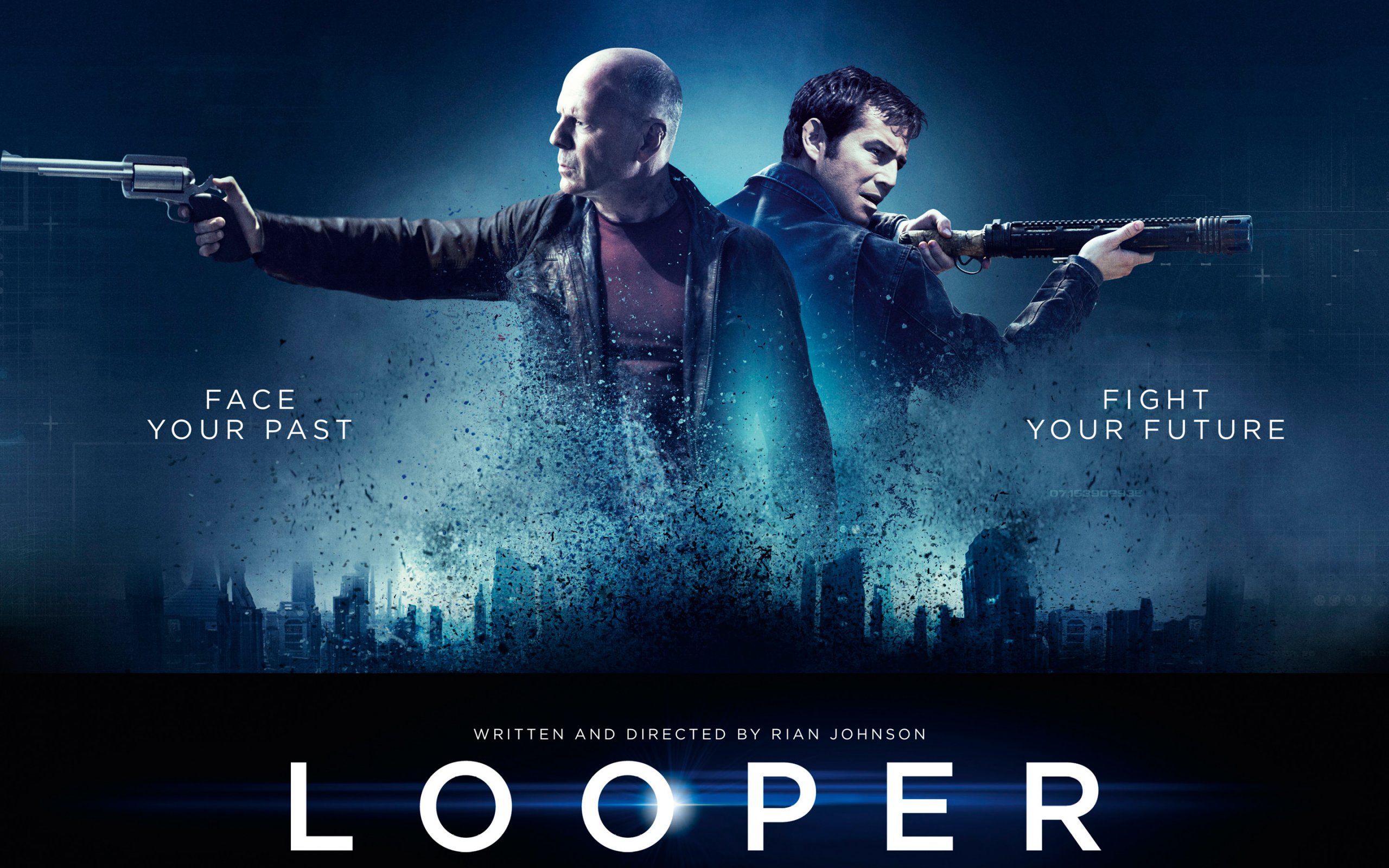
The story revolves around Joe, a looper living in 2044, where economic collapse in the United States has left cities at the mercy of organised crime. At the same time a “genetic mutation” has occurred in 1 in 10 people giving them telekinetic ability to levitate small objects. In the course of his duties, Joe discovers that his mob clients in 2072, want to “close the loop” by transporting his older self (“Old Joe”) back to 2044 for Joe to kill him, strapped with the final payment of course – the customary way of ending contracts! Unfortunately, Old Joe has not come to die and that’s when trouble begins for Joe. The mob starts chasing him, led by Abe and his “Gat Men”. At the same time Joe has to contend with Old Joe who has his own plans to change the course of history.
The story revolves around Joe, a looper living in 2044, where economic collapse in the United States has left cities at the mercy of organised crime. At the same time a “genetic mutation” has occurred in 1 in 10 people giving them telekinetic ability to levitate small objects. In the course of his duties, Joe discovers that his mob clients in 2072, want to “close the loop” by transporting his older self (“Old Joe”) back to 2044 for Joe to kill him, strapped with the final payment of course – the customary way of ending contracts! Unfortunately, Old Joe has not come to die and that’s when trouble begins for Joe. The mob starts chasing him, led by Abe and his “Gat Men”. At the same time Joe has to contend with Old Joe who has his own plans to change the course of history.
In the most dramatic exchange, Old Joe and Joe are sitting in the diner when Old Joe explains that the reason he has come back to 2044 is to kill the “Rainmaker”, a child who will grow up to be evil and eventually ruin Joe’s life! Old Joe does not know the exact identity so he must eliminate three possible children in the frame to be absolutely certain. Joe rejects Old Joe’s plan not because he is uncomfortable with taking young life but because he wants to fulfil his dreams of moving to France and killing Old Joe is key if the mob are to let him live! Therein lies the moral dilemma on which the movie rests is clear. Old Joe wants his “good life” back and a world free from the intolerable suffering that will be induced by the Rainmaker. He has power to change it but at a huge cost to innocent lives. Does Old Joe have a right to take life if it will save his life, the lives of those he loves, and ultimately the world?
It is an important moral question and one that the movie struggles to answer. The script initially appeals to the importance of innocence. As Old Joe pursues the young Rainmaker we continue to be reminded that “he is a good boy” and "a great kid". And though there are moments when he instils the audience with fear, his “goodness” is apparent, especially in those moments when he acts as an ordinary boy but also even when he uses his special abilities to protect others. Given that innocence and goodness, the movie powerfully seeks to show that Old Joe’s attempted is clearly banal. But this only raises further questions, not least because with so many competing voices in the movie (some from the future) we are left to ask – who decides what is good? In a movie where people are merely products of genetic mutations, it is not clear on what basis the boy is judged good at all. Goodness requires an objective moral standard on which we can judge competing alternative. We need a basis on which we can rightly compare the moral standing of Old Joe and his demands and that of the young Rainmaker. Since that is not resolved we are left completely dissatisfied or worse with the Director as our moral conscience.
An equally unsatifictory appeal is made to the “greater good” framework. I think we are not giving away much by noting that the issue of how the moral dilemma is ultimately resolve comes down to what the Director regards as the best way of “closing the loop” for everyone! What achieves the best outcome for society? In the end it comes down to a vital question of whether by Old Joe trying to kill the young Rainmaker, he might succeed in ensuring a better future for everyone. Is the action able to lead to the greatest happiness of the largest number? This is the utilitarian ideal that defines much of western thinking and of course underpins all economic thinking. This worldview falls into the same problems as the attempt to seek moral refugee in innocence. For utilitarianism to form a reasonable basis for moral resolution everyone has to believe not only in what good is, but also that achieving that good is the greater good. But who decides what is good for everyone in the first place? Who has the appropriate right to act and on what basis? At the heart of the utilitarian framework is that we Gods! It is us who must determine what the greater good is not some external God. The worldview promoted in the movie stands in stark contrast to the biblical worldview which says that all of life is in God's hands. It is not our role to shape or alter it or decide who lives and dies. It is not merely a question of innocence or the greater good, it a question of sovereignty.
There are other interesting moral issues that discerning viewers will spot in the movie. For example, there are some interesting questions about the nature of reality and time itself. There’s also the question of the relative value of the future with respect to the present. Joe believes killing people from the future is morally defensible because those people don't exist yet. Is he correct? There are also questions about the extent to which the future is entirely dependent on the present. Is the future fixed or indeterminate?
Cinematically, the movie does suffer from incomplete sub-plots which aren’t developed holistically e.g. Joe's first girlfriend, the waitress or Abe. Indeed the Old Rainmaker does not feature at all, which is perhaps a weakness because it fails to bring to life the nature of the threat he poses and therefore leaves some viewers perhaps too Old Joe’s broader fears. There are also bizarre moments especially sudden character changes and unnecessary violence (how many times does Joe have to shoot before we get it?).
Despite these wrinkles the movie is engaging with commanding performances from Willis and Gordon-Levitt. Emily Blunt who plays the Rainmaker’s mother also does a great job as a fearless independent woman battling addictions and struggling to bring up a child with rather bizarre special abilities. And of course there are enough issues to spark endless thoughts and discussions among friends about nature of man, free will, determinism, reality and time travelling.
Comments
Post a Comment